A Chair Cannot Lie
2026-05-13 · 10 min read
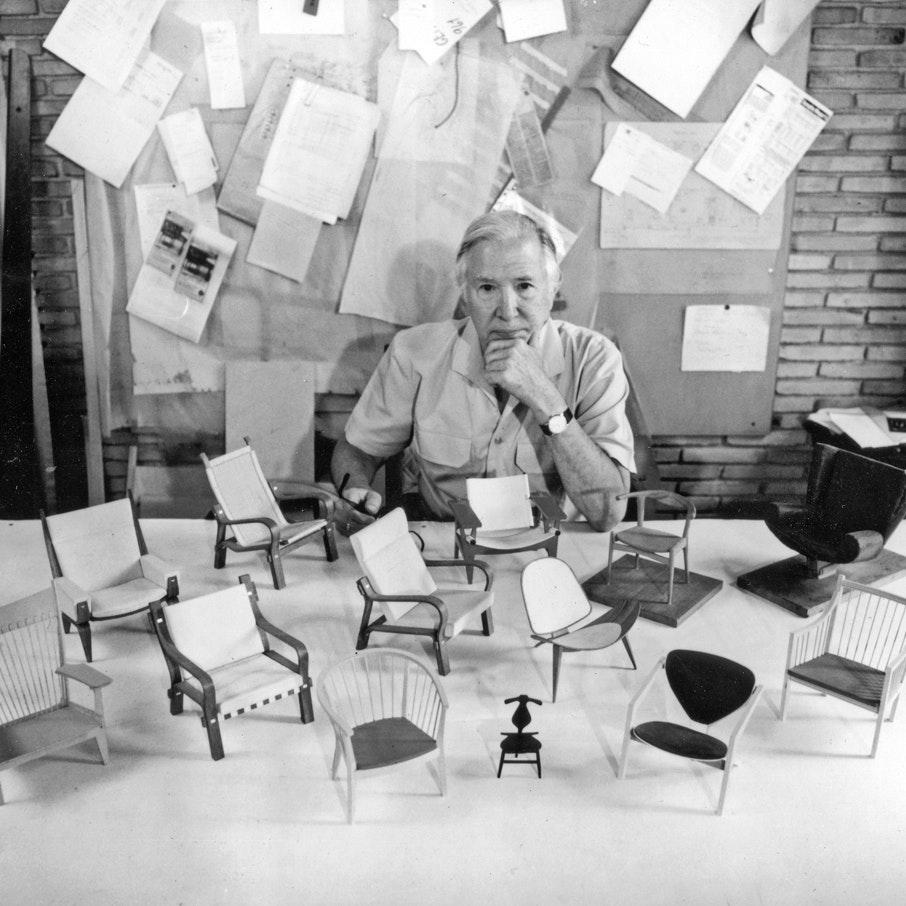
Hans Wegner was born in 1914 in Tønder, a town in southwestern Denmark near the German border whose architecture and language had passed back and forth across the line several times in living memory. His father, Peter Mathiesen Wegner, was a cobbler. The street where Hans was raised, called Smedegade, was the kind of small Danish street where every house looked like every other one, and where the children grew up watching their parents work leather and wood with their hands.
At fourteen Hans was sent to apprentice with a master cabinetmaker named H. F. Stahlberg. He made his first chair at fifteen. He finished his apprenticeship at seventeen by building a lady's desk that the older cabinetmakers in the workshop judged with their own bodies and hands. This was how the Danish guilds had certified craftsmen for centuries. You did not graduate by passing a multiple-choice test. You graduated by building an object that other people who had spent their lives building objects could examine and decide whether it would hold. The artifact was the test. The institution was honest enough to be answerable to the thing it produced.
He moved to Copenhagen, studied at the School of Arts and Crafts for two years in the late thirties, worked in Arne Jacobsen's office designing furniture for Aarhus City Hall, and eventually went out on his own, partnering with a master cabinetmaker named Johannes Hansen. Over the course of his career he would design something close to five hundred chairs.
He talked about the work, when he talked about it, in a few ways that have stayed with the people who care about chairs. He said a chair was to have no back side, that it should be beautiful from every angle, because chairs are used by people who walk around them and pull them out and push them back. He said a chair was only complete when someone sat in it. He said the work he was doing on the Round Chair, the one he showed at the 1949 Copenhagen Cabinetmakers' Guild Furniture Exhibition, was an exercise in stripping the old chairs of their outer style and letting them appear in their pure construction. He said the good chair was a task you were never completely done with.
What he meant, across all of these, was that the chair could not lie about what it did. Gravity was the test. The body was the test. A chair that looked correct in the photograph but failed under a person was not a chair. A chair that survived the photograph because it was actually engineered to hold the body was a chair. There was no proxy. There was nothing the chair could substitute for the verdict of an actual person actually sitting in it.
The chair under a president

Eleven years after the Copenhagen exhibition, on September 26, 1960, his chair ended up under a man whose back had been wrecked since the war.
John F. Kennedy walked onto the set of the first televised presidential debate in American history at a CBS studio in Chicago. He had suffered chronic back pain since a Japanese destroyer cut his patrol boat in half in the Solomon Islands in 1943, an injury his political team had spent the entire campaign trying to keep out of the press because they correctly suspected the country would not elect a candidate it perceived as physically fragile. The chair on the set was Wegner's Round Chair. Both candidates sat in versions of it. For sixty minutes, in front of seventy million Americans, Kennedy looked composed in his chair while Nixon visibly suffered in his.
The famous detail about that debate is that radio listeners thought Nixon had won and television viewers gave it to Kennedy. The medium was rewarding qualities the previous medium could not perceive, and one of those qualities was the visual fact of a body at ease in a beautiful piece of furniture. The chair was part of the surplus. It was not what the candidates had come to debate. It was the silent infrastructure that made the debate possible to watch.
Kennedy and Wegner never met. The Danish cabinetmaker had spent decades on a problem about where a shoulder meets a backrest, and the result of that work, almost incidentally, was that an American politician with a broken back looked presidential for sixty minutes on a Tuesday night in September. The chair is now in the permanent collection of the Smithsonian's National Museum of American History. It is one of the very few pieces of furniture in the building that holds its own weight as a historical artifact, because what happened in it actually mattered, and the chair was load-bearing for what happened.
What the chair did not do, and could not have done, was vouch for the body it held. Kennedy in September 1960 was sicker than the public was permitted to know. He had been diagnosed with Addison's disease years earlier, a diagnosis his physician and political team had spent the campaign denying through a careful technicality. He was being treated with corticosteroids. In the days before the debate, a New York doctor named Max Jacobson, who would later be exposed as a serial injector of methamphetamine and steroids into prominent patients, gave him his first dose of what was passed off as a vitamin shot. The chair held a body that was performing health it did not actually have. The chair did its job. The body brought its own moral weight to the room.
The chairs we sit in now
I have been thinking about this chair for a long time because I have been thinking about institutions, and a chair turns out to be the cleanest available picture of what an institution is supposed to be.
A chair has to obey gravity. There is no version of a chair that markets well, certifies well, accredits well, and then collapses when the body arrives. The chair is its own verdict. The institution that produced Wegner was the same way. You were a cabinetmaker when other cabinetmakers, examining the chair you had made, agreed that it held. The institution and the artifact had the same test, and the test was the body.
Most institutions in modern life have escaped this kind of test. They have learned over the last half century to substitute something else for the body's verdict. The university is the most obvious example, because the credential it sells has visibly come unbundled from the education it claims to provide. A degree is a number that can be moved. A student's actual capacity to think is harder to measure, harder to standardize, and increasingly orthogonal to whether the institution can demonstrate success in its annual reports. The customer service phone tree is the same shape on a smaller scale. The institution measures call resolution time and self-service rate and the fraction of inquiries deflected before reaching a human, and every one of those numbers can be optimized while the person on the line is having a worse experience year over year. The local newspaper that hollowed out across two decades, the civic association whose membership rolls thinned without anyone quite noticing, the church whose attendance held while the names of the people in the pews became unknown to one another, are all variations on the same story. The institution kept a number visible. The body in the room stopped being held.
Wendell Berry, in a 1981 essay called Solving for Pattern, said it better than I will. A bad solution acts according to the pattern of organic disease or addiction; it causes a steady worsening of the condition it is intended to cure. He was writing about industrial agriculture, but the pattern is general. The institution that solves for the wrong variable does not just fail to solve the right one. It deteriorates while it succeeds, and the success makes the deterioration harder to see.
One clarification before going further. The test is not whether the body in the chair feels held in the way it most wants to be held. Some chairs are designed for adversarial work. The court has to deliver verdicts the defendant experiences as a refusal. The regulator has to deliver findings the regulated company experiences as constraint. The teacher has to fail the student who has not earned the grade. These institutions are doing the chair's work by holding bodies through outcomes those bodies did not choose. User satisfaction is not the test. The test is whether the body that should have been held was held, and whether the chair was honest about what it was doing.
The temptation of no chair
What is happening now, with the arrival of AI in the workflows of nearly every consequential institution, is that the bad chairs are getting exposed at unprecedented speed. A model can produce a discharge summary, a syllabus, a court filing, a sermon, a customer service script. Most of the apparent activity of most institutions can now be generated cheaply and at any volume by a system that did not pass through the institution. The ornament has gotten free.
The appealing thing about this moment, and the dangerous thing, is that the model is in some ways more accountable to the user than the institution it is replacing. You ask, you receive, you can tell whether it worked. The accountability is direct in a way that institutions stopped being accountable a long time ago. The university takes four years to tell you whether what it did mattered. The phone tree takes forty minutes to fail you. The model takes four seconds. People are not wrong to find this appealing. They are responding rationally to a long pattern of institutional failure that AI did not create but is honest about.
Wegner has another line that I want to put down here, because it is the one that complicates the dissolution. A chair is only complete when someone sits in it. The chair is incomplete on the showroom floor. It is incomplete in the patent drawing. It is incomplete in the photograph. The body sitting in it is what completes it.
The model can answer the question. It cannot sit in the chair. Some of what a chair does, the holding of a body in pain over time inside a community that knows you, cannot be done by a thing that does not know you. The doctor who has known your family for twenty years is not a slower version of the medical chatbot. The neighbor who shows up at your door when your father dies is not a less efficient version of the grief journal app. The teacher who sees something in you that you have not yet seen in yourself is not a worse version of the tutor that adapts to your inputs. The dissolution of the chair into a service is not the same as being held.
This is the Underground Man's mistake in new clothes. He preferred the absence of friction to the presence of warmth, and he was correct that the friction had been doing something cruel, and he was wrong that escaping it would leave him with anything worth keeping.
Carving better chairs
The chair is the right test. The institutions we have are mostly not chairs anymore, and AI is going to keep stripping the ornament until only the load-bearing parts remain. That stripping is not the death of the institution. It is the question the institution has been avoiding for fifty years, asked at a volume it can no longer pretend not to hear.
What survives the stripping is whatever was actually holding a body. The teacher who knows the student. The judge who hears the case. The doctor who sits at the foot of the bed and looks the patient in the eye. The reporter who knows the town she covers. The pastor who is in the room when the family is grieving. These are not nostalgic figures. They are descriptions of the chair when the chair is doing its job. The work in front of us is to design institutions around them rather than around the proxies that displaced them.
The new chairs also have to hold bodies the old chairs explicitly refused. The civic institutions of mid-century America held some Americans and excluded others, and the thinning of those institutions across the second half of the twentieth century was, in part, a correction. Whatever gets carved next inherits the obligation to be a chair for everyone the previous chairs were not.
Some of this work is already happening. New York City passed Local Law 136 in 2017, establishing a right to counsel for low-income tenants facing eviction in housing court. The institution is small and specific. A lawyer sits in the room with the tenant for the duration of the case. The chair is the relationship of accompaniment through an adversarial process that the tenant, alone, would not have survived. Eviction filings in covered zip codes dropped sharply after implementation, but the more important point is what got rebuilt. A piece of civic infrastructure now exists where there used to be none, and what it does is hold a body the system was previously designed to process. Several other cities have followed. There are versions of this work in housing, in legal services, in community land trusts, in small civic journalism efforts, in mutual aid networks that took on shape during the pandemic and did not dissolve afterward. None of them are at scale. All of them are chairs.
I do not think Berry would endorse most of the technology I write about and use every day. He has spent fifty years arguing against precisely the kinds of substitutions that this essay is, in part, defending. I take his diagnosis seriously while making a different bet about the prescription. His account of why the institutions failed remains the cleanest one I know. A viable community, he wrote in Conserving Communities in 1992, is made up of neighbors who cherish and protect what they have in common. The chair we are trying to build is the small set of arrangements under which neighbors can still recognize each other as neighbors, the small institutions that are answerable to the bodies they hold, the small civic spaces where the test is whether anyone was actually known.
This is a small and unfashionable place to argue from, closer to Berry and to the Catholic teaching on subsidiarity than to either the institutional defensiveness of the contemporary left or the demolition appetite of the contemporary right. The institutions worth keeping are the ones that pass the body's test, and the work of building them is neither restoration nor revolution.
There is a sentence from the Gospels I have been thinking about while writing this, which Jesus says when the Pharisees criticize him for healing on a day of rest. The Sabbath was made for man, not man for the Sabbath. The institution exists for the body. The body does not exist for the institution. When the order reverses, the institution has stopped being a chair and become something else, something more like a cage, something whose continued existence requires people to keep submitting to a test it administers rather than a test it has to pass.
Hans Wegner was a Danish cabinetmaker who articulated, in the way craftspeople sometimes do, the test that all serious institutions used to pass and most have stopped passing. The body is the verdict. The chair is honest about what it does. The work of carving new ones is patient, specific, and unfinished.
The good chair is a task one is never completely done with.