The Priesthood of All Patients
2026-04-29 · 11 min read
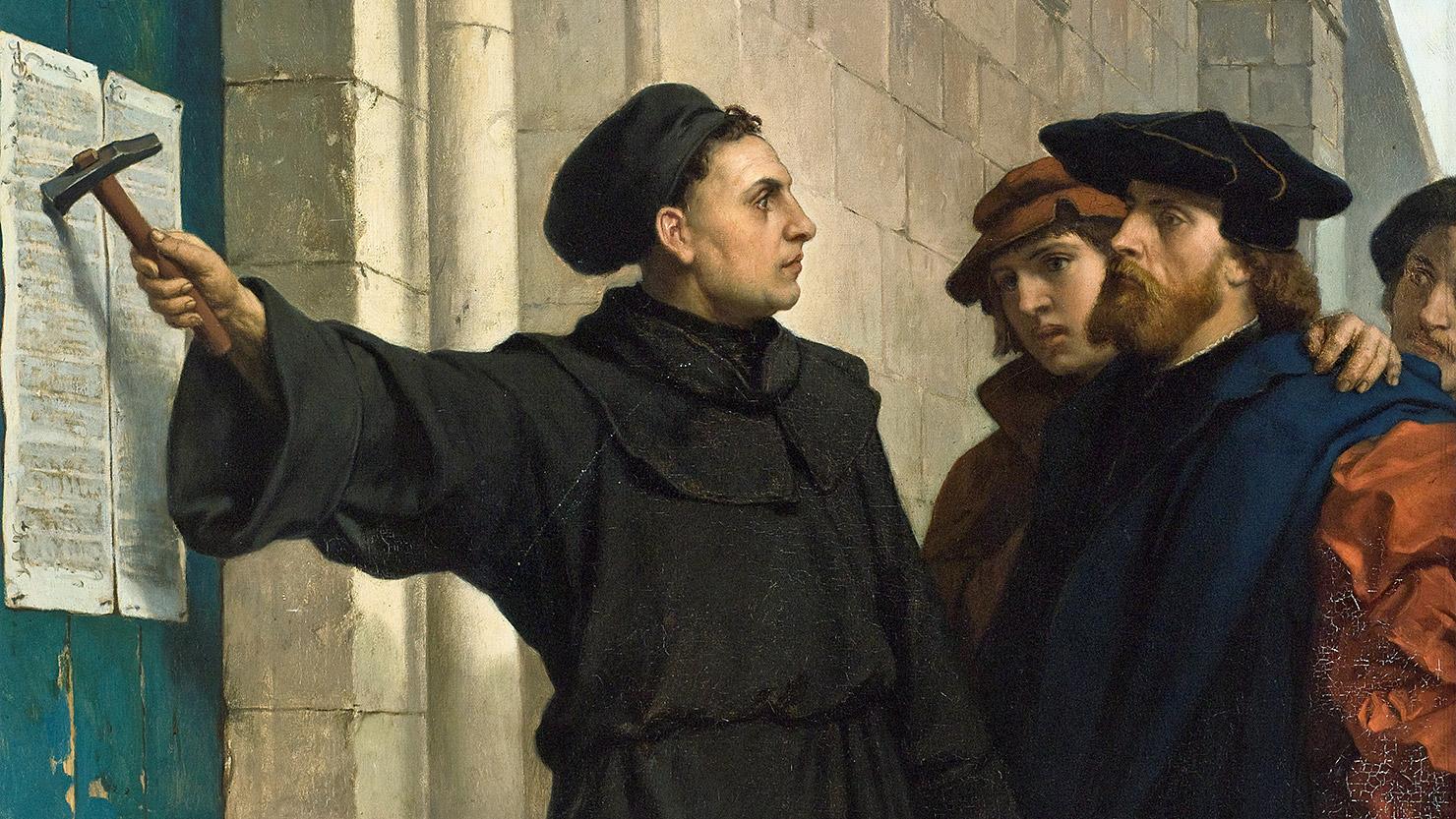
In 1517, Martin Luther nailed his theses to a Wittenberg church door, and within months his arguments were moving across Europe in vernacular translations, because Gutenberg's press had made it possible to put a thinker's words in a peasant's hands without an institution in between. Within a decade, ordinary literate Germans could read Scripture themselves, in their own language, with no priest standing between them and the text.
The pre-Reformation Catholic Church was, among other things, an interpretive monopoly. Salvation flowed through sacraments, sacraments flowed through priests, and Scripture itself sat in a language most laypeople couldn't read, while the apparatus of interpretation (councils, encyclicals, canon law) was the sole property of the institution. None of this was purely cynical, because theology is genuinely difficult, heresy has real consequences, and most peasants of the period could not read anything at all, much less Greek, much less the layered metaphysics of Aquinas. The institution was solving a real problem, which was how to preserve a coherent body of difficult ideas across centuries and continents without it disintegrating into a thousand local variants.
Luther's claim was not that the Church should disappear but that a priest is not metaphysically necessary between a person and God, and that the text itself, in your own language, was something you had a right to access. Sola scriptura. Priesthood of all believers. The press made it technically possible; the theology made it culturally legitimate.
The good fruits of the upheaval that followed were enormous, including literacy, individual conscience, accountability, and most of the conceptual scaffolding that gives us modern liberalism. The bad fruits were also enormous. The Wars of Religion killed millions of Europeans over questions that had previously been settled, however imperfectly, by an institution. Denominations fractured into denominations into denominations, and with no agreed-upon interpretive authority, every literate person became a potential heresiarch. By the 19th century, anyone in America who could write a tract could start a religion, and by the 20th, televangelists had figured out that the priesthood of all believers was extremely compatible with selling miracle healing on cable TV. The grift, as grift does, mutated to fit the medium.
The reformers were right that agency matters and that institutional authority calcifies, but they were less careful about a third question, which took two centuries of war and schism to answer. What replaces the institution you've torn down? That same question is now being asked of medicine, which has been operating for most of a century as an interpretive monopoly of its own.
The Latin Bible of Your Body
Your medical record is your story, but it's written in a language you can't read. Lab values, ICD codes, imaging reports, medication interactions, all of it is technical vocabulary inside guild conventions, accessible only through the clinicians who can interpret it for you. HIPAA was originally written to give you portability and access, but in practice the data lives in incompatible silos owned by hospital systems, scattered across patient portals you can't aggregate, and summarized in clinical notes written for other clinicians rather than for you.
If you want to know what is actually wrong with you, you need a priest, and the priest is usually well-intentioned. Medicine genuinely is hard, diagnostic reasoning genuinely is a craft, and most people genuinely cannot read a chest CT or reason their way through a differential of abdominal pain. The institution is solving a real problem, the same way the medieval Church was solving a real problem, and pretending otherwise is dishonest.
But the institution has also calcified into a great deal that has nothing to do with the underlying difficulty of medicine. Certificate of Need laws prevent new clinics from opening because incumbent hospitals don't want competition. Scope-of-practice rules limit what nurses, pharmacists, and physician assistants are allowed to do, in ways that have more to do with guild politics than with patient safety. Insurance prior authorization is canon law administered by bureaucrats with quotas. Clinical trials are run by institutions that own the data, while the patients who provide the tissue and the symptoms and the years of waiting do not own the findings. You are the subject of your medical story, not its protagonist, and for most of the twentieth century there was no plausible alternative, because the cost of getting an expert's interpretation was high enough to make the system effectively unbundling-resistant. There was no printing press for medicine.
The Printing Press
AI is the printing press, and what matters about it is not that it generates text. What matters is that it has made expert interpretation almost free. A patient with their full medical record and a competent model can now do something that was impossible five years ago, which is to read their own chart in plain language, ask follow-up questions, compare it against current literature, and form a working understanding of their own situation. They can flag a medication interaction the doctor missed because the visit was eleven minutes long. They can notice when their symptoms cluster in a pattern that wouldn't have fit into any single appointment. They can join registries, find people with the same rare disease, and contribute to research without waiting for a specialist clinic three states over to design the study they happen to qualify for.
Other unbundlings are happening at the same time, and most of them are downstream of the same forces. Ambulatory surgical centers are siphoning routine procedures out of hospital monopolies and doing them better and cheaper. Direct primary care is bypassing insurance for routine encounters and rediscovering, in the process, what an unhurried doctor's visit feels like. Genetic testing has gone direct-to-consumer, and continuous glucose monitors are migrating from diabetics to anyone curious about their metabolism. The legal architecture is shifting too, as states repeal CON laws, expand scope of practice, and start treating patient data as patient property rather than as hospital property.
The pre-Reformation system is breaking down whether anyone has a coherent plan for what comes next, because the vernacular has arrived and people are going to read their own charts. The real goods of this are worth naming. Patients caught in long diagnostic odysseys will find answers faster than they did when they were dependent on a single overworked physician with a fifteen-minute appointment slot. Conditions that get dismissed in those visits, especially the ones that disproportionately affect women, the elderly, and racial minorities, will start getting serious attention from tireless silicon advocates that don't tire and don't condescend and don't decide that the patient is exaggerating. Research will accelerate as patient-contributed data scales beyond what any single institution can collect on its own. Geographic monopolies will lose the ability to ration care to whoever happens to live near them. The total amount of working medical knowledge sitting inside the population will rise dramatically, and that is on balance a good thing, even after you account for the things that come with it.
What the Reformation Cost
Luther did not anticipate Joel Osteen, and he could not have. But the line from sola scriptura to a Houston megachurch selling private-jet anointing oil is not hard to trace once you start looking, because once you have established that any believer can read Scripture and form their own understanding, you have also established that any charismatic con artist can claim divine authority and find an audience for it. The same press that produced the King James Bible produced a thousand pamphlets predicting the imminent end of the world. The liberty that allowed for Quaker pacifism allowed for snake handling. You don't get religious unbundling without also unbundling the social filters that kept out the grift and the madness, and the medical version of that bargain is being struck right now.
The wellness industry already grosses tens of billions of dollars selling unproven supplements, cleanses, and biohacking protocols, much of it dressed in the visual grammar of medicine without any of the underlying rigor. Anti-vaccine movements have cost lives in countable numbers of dead children. Long COVID communities, which were correct that something real was being missed when official medicine was dismissive of them, also produced subgroups convinced of elaborate parasitic theories that map onto no known biology, and most of those subgroups will not be talked out of their theories by a doctor or anyone else. Each Telegram group is its own denomination, each influencer its own televangelist, the whole arrangement sometimes partially right, sometimes delusional, almost always unaccountable to the people it harms.
AI will accelerate all of this. An AI confidently telling a hypochondriac that she has Lyme disease and mold toxicity and chronic EBV (which she doesn't) is a more compelling priest than a TikTok shaman, because the AI sounds like a doctor and uses the doctor's vocabulary. Add confirmation bias and model hallucination and the natural human craving for a name for one's suffering, and you get an enormous expansion in the number of people holding private medical interpretations that conflict with consensus medicine and that they will not surrender on any timescale that matters.
There are coordination costs too, which the religious analogy can obscure. Public health requires institutions in a way that private salvation does not. The COVID vaccine rollout, for all of its real failures, demanded a level of population-scale logistics that no amount of individual patient agency would have produced on its own. Antimicrobial stewardship requires that not every patient gets the antibiotic they want when they want it. Vaccine schedules require that somebody keep the schedule. A medicine of pure individual sovereignty produces measles outbreaks, and it does not produce a polio vaccine.
And then there is the worry I find hardest to dismiss, which is the one about tacit knowledge. Modern medical institutions, despite all of their pathologies, contain accumulated wisdom that is not legible from outside the institution. Some of what looks like wisdom is really just guild protection, dressed up in clinical language and resistant to challenge for that reason. But a real fraction of it is genuine, earned over decades of trial and error, paid for in dead patients, encoded in habits and intuitions and norms that no one ever wrote down because nobody knew they needed to. Burn the institution and you burn that with it, and not all of it can be reconstructed from first principles by a model trained on the published literature.
Two Centuries Later
The Reformation took roughly two centuries to stabilize into something workable, and what it stabilized into was not what Luther proposed. It became a polycentric system of many denominations, each with its own interpretive tradition, training institutions, accountability structures, and relationships to civil authority. Within each tradition, professionals were trained, credentialed, and held to standards. Across traditions, ecumenical bodies emerged for coordination on shared concerns, and universities, many of them founded as religious institutions, became sites of contested but rigorous interpretation. The Catholic Church itself reformed, slowly and painfully, through the Council of Trent and eventually Vatican II, vernacular liturgy, lay participation, and a long quiet acknowledgment that the laity were not going back into silence. The institution did not vanish so much as it adapted, and the adaptation took longer than anyone alive to see it begin.
What actually survived was not the priesthood of all believers in any radical form. Almost no Protestant denomination today operates as a leaderless community of equals reading Scripture together with no clergy at all. They have pastors and seminaries and liturgies and traditions of interpretation that take years to learn, and someone is responsible for getting it right or at least for being held accountable when they get it wrong. The Reformation, in retrospect, was less a question of whether expertise should exist than of who the expert was accountable to. Pastors became answerable to their congregations rather than to bishops, seminaries to their traditions rather than to Rome, and authority got redistributed and constrained without being abolished. That is, more or less, the shape medicine is going to have to settle into, assuming it settles.
A Reformed Medicine
The version of all this worth wanting is not the abolition of doctors, and it is also not the digital wellness anarchism that the more reflexive techno-optimists are happy to imagine. It is something in between, and the rough features of it are already visible if you pay attention.
Patients own their data, fully and portably, the way Protestants own their Bibles, and AI is the universal translator that makes the data legible to them. Doctors stop being gatekeepers and start being consultants and advocates, with their value concentrated in interpretive depth, longitudinal relationship, and judgment under uncertainty, which are all the things AI is bad at. The fee structure shifts toward paying for thinking rather than for procedural monopoly, which is the part the existing system most resists, because it is the part of the existing system that most resembles a rent.
Professional guilds remain, but their authority is reformed. Specialty boards function more like denominations than like cartels: they certify training, share protocols, run journals, and hold members to standards, but they are not monopolies on practice. They earn authority by being good at what they do, and they are exposed to competition from institutions that argue they are better. CON laws are gone. Scope of practice expands so that pharmacists prescribe more, nurse practitioners run primary care, and new kinds of clinicians, including AI-augmented ones, become possible without requiring a special exemption from somebody else's lobbyists.
Some things stay unified anyway, the way the Nicene Creed stayed unified across most denominations even after everything else fragmented. There is a shared commitment to evidence, to safety reporting, to participation in registries, and to honest disagreement about hard cases. Public health authorities exist with real but narrow responsibilities: vaccines get coordinated, outbreaks get tracked, antibiotics get stewarded, and that is most of what they do. This is the ecumenical layer of the system, and it works because it is narrow and durable and known to be those things. The lesson of the last decade of public health, painfully learned, is that an institution which keeps expanding past its core competence loses the trust it needed for the core, and trust does not come back on the timescale that lost it.
Universities and research institutions are the cathedrals of this version. They produce knowledge, train clinicians, and publish openly, but they are not the only places where care happens or where research happens. Distributed trials let patients participate from anywhere. Patient communities help author the research questions, rather than waiting for academic medicine to notice them. Open data lets independent analysts check the work, which means replication starts being a default rather than a novelty.
The grift survives all of this, because it has to. There will still be AI wellness apps selling magnetic bracelets, influencers blaming all disease on seed oils, private interpretations that are wrong and patients who suffer for believing them. The answer is not to recriminalize lay interpretation, because that horse left the barn long before AI did. The answer is to build the social technologies that help people navigate the new landscape, including schools and professional societies and journalistic infrastructure and AI tools that flag their own uncertainty, but also patient health literacy as a real curriculum rather than a leaflet, and AI auditing as a profession rather than a hobby. The Reformation eventually produced biblical scholarship, hermeneutics, and comparative theology, and the medical equivalent will need analogous tools so that "I asked the model" gets treated the way "I read the Bible" eventually got treated, which is as a starting point rather than as a final authority.
The Pace Problem
The Reformation took two centuries to settle, and we don't have two centuries.
AI capability is compounding on a timeline of months, while medical school curricula are revised over years, specialty boards move slower than that, and the FDA is not built for software that updates every Tuesday. State legislatures, even the ones already repealing CON laws, are running a generation behind the technology, and there is no practical way to slow the technology to let them catch up, because the models are out in the world and a teenager with a phone has access to the same ones a Mass General fellow does. The only thing actually available to speed up is everything else. Medical schools could be training clinicians to work with AI-augmented patients rather than against them. Patient organizations could be organizing for data rights and taking that work seriously. Open-source medical AI could be treated as a public good, with auditing and accountability built in from the start. Public health agencies could be earning back trust by being narrow, honest, and durable, which is harder than it sounds. Insurance is the part of the old system most likely to break first, and the question of what replaces it deserves more attention than it is currently getting.
The deepest insight of the Reformation, in retrospect, was not that authority is bad. It was that unquestionable authority eventually fails badly, and that the people most affected by an institution have a moral claim to participate in interpreting it. Medicine is at that point now. The patient, who has been the subject of medicine for a long time, is becoming a participant. What remains to be seen is whether the institutions help shape what that participation becomes, or whether it gets shaped without them.